
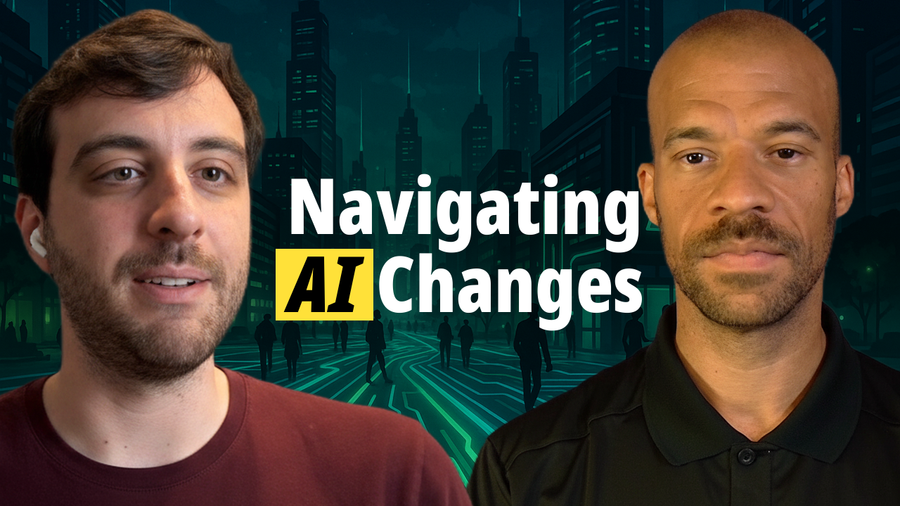
AI Isn't Coming for Your Job — But Your Relationship With Busy Work Is About to Change Forever
We're at an inflection point. AI isn't a future trend to monitor — it's already inside the businesses, careers, and economic structures that shape daily life. The people who understand that early are the ones who'll be positioned when the dust settles.
Jordan Finneseth sits down with Johnny Gabriele, CEO and co-founder of Daedalus Consulting, for a candid, boots-on-the-ground conversation about what AI is actually doing to industries, how small and mid-sized businesses are adapting, and what the shift from SaaS to bespoke AI infrastructure really means for the economy.
They also dig into the producer-versus-consumer divide, the dopamine trap hiding inside AI productivity culture, and what people at every career stage should be doing right now.
This is signal, not hype.
This session was recorded on April 8, 2026.
Key Takeaways:
We're in the "Every Pizzeria Needs a Website" Phase of AI
- Johnny's central thesis: we are at the exact same inflection point with AI that the early internet created for web developers in the early 2000s — a window where people who learn the tools early will build outsized advantage before the market catches up
- Just as Squarespace eventually commoditized basic web development, AI tooling will eventually commoditize today's early-mover advantage — but that window is open right now, and it's wide
SaaS Is Dying — Bespoke AI Is Replacing It
- Johnny's firm, Daedalus Consulting, is built on the thesis that SaaS is in structural decline
- Large CRM and project management platforms like HubSpot and Salesforce are particularly vulnerable — businesses can now build custom versions of these tools in a fraction of the time and cost
- Exceptions: tools with deep infrastructure complexity (QuickBooks, Gmail) are unlikely to be displaced, but anything that's essentially a UI layer on top of data is at risk
- Johnny's team operates with only two paid subscriptions — Claude and Cursor — and builds everything else in-house, including their own CRM, meeting note system, and contract signing tool
The Real AI Opportunity: Eliminating Busy Work, Not People
- One of Daedalus's medical clients had staff spending 45 minutes per patient scan copying and pasting billing codes and notes. An AI agent now does it in 30 seconds — and no one lost their job
- The freed-up time went back to human interaction: staff can now actually talk to patients, build relationships, and do the work that requires a person
- Johnny's framing: AI gives back the "human stuff" — the high-touch interactions that got squeezed out by administrative overhead
- This shows up in retention, satisfaction, and ticket sizes — not always directly in the bottom line, but measurably in business health
The Brain vs. The Harness — Why the Model Alone Isn't the Story
- The LLM (Claude, GPT, Grok) is the brain. The harness (Cursor, Claude Code, ChatGPT interface) is the body
- Both are improving simultaneously — and that dual compounding is what's making AI feel like it's accelerating faster than people expected
- Johnny's team rotates between harnesses every few weeks based on what's performing best, treating the stack as a living system rather than a fixed setup
- His current preference: Cursor with Claude as the underlying model
The Dopamine Trap — The Risk Nobody's Talking About
- Johnny flagged a concern he called the most important thing he didn't want to leave unsaid: AI creates a powerful dopamine loop that can mimic productivity without producing real output
- The risk: entrepreneurs and go-getters spend hours optimizing their AI setup, sharing GitHub repos, and feeling productive — without actually shipping anything or moving the needle
- His personal discipline: constantly asking himself whether he's actually producing value or just chasing the feeling of productivity
- The distinction between producers and consumers becomes sharper in an AI-accelerated world — consumers will find new ways to consume, and some entrepreneurs will accidentally join them
Career Advice by Stage
- Early career: There may be short-term pain similar to 2008. Consider grad school or skill-building roles that aren't dream jobs yet — use the time to build a foundation. The disruption is real but temporary
- Mid-career: This is the highest-risk group for complacency. Even Johnny says he's afraid of AI replacing his current role — and he builds AI for a living. The advice: act as if your job is replaceable, because the downside of being wrong is far worse than the upside of being right. Lean into discomfort deliberately, the same way you'd go to the gym
- Late career: Your accumulated knowledge and experience are enormously valuable — and AI is going to extract that knowledge one way or another. The question is whether you participate in that process and get compensated for it, or whether it happens without you
The College Question
- Johnny's view: college isn't going the way of the dinosaur as fast as SaaS, but the essay as a knowledge-testing mechanism is effectively dead
- The better model, demonstrated by a UConn professor Johnny knows: teach however you want, use AI however you want — but you have to be able to stand in front of me and explain your work without any technology. That's the real test
- College's enduring value isn't the knowledge transfer — it's the structured environment, the interpersonal friction, and the skill tree. Those things don't disappear with AI
- The $17–$20/month AI subscription is collapsing access barriers that used to be geographic and economic — that's genuinely exciting and worth paying attention to
The One Structural Change AI Will Force on Society
- Johnny's bet: AI will reshape office and company culture as dramatically as COVID did — possibly more
- As agents take on more employee-like functions, the physical nature of work, where people go, how teams are structured, and what "showing up" even means will look fundamentally different within 10 years
- His hope: fewer cubicles, more couches — and a working world built around human creativity and relationship rather than administrative presence
#AIStrategy #FutureOfWork #BullrunBunker #ArtificialIntelligence #StrategicPositioning


Comments
Sign in or join the 1% who know more than the 99% to read and leave comments.