
Institutional Rails and the End of the Bridge Era: What a Quantum-Resistant Settlement Layer Actually Requires
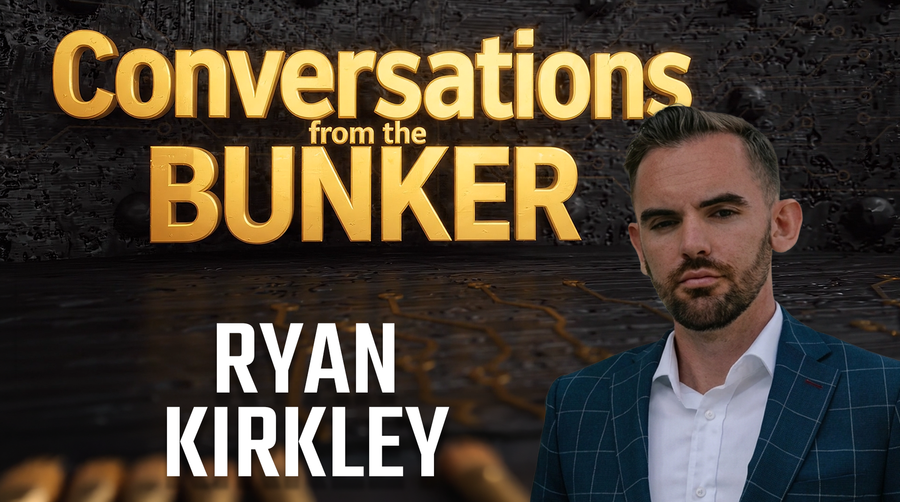
This episode of Conversations from the Bunker with Ryan Kirkley, CEO of Global Settlement Network, approaches blockchain infrastructure not as a speculative asset class but as a settlement problem — one that existing bridge architectures, stablecoin rails, and fragmented chain ecosystems have not yet solved.
The lens is that of a practitioner who has spent a decade at the intersection of venture capital and protocol development, and who is currently building a layer-one blockchain designed specifically for regulated institutional use: banks, governments, central bank digital currencies, and cross-border liquidity providers.
The conversation surfaces several areas of genuine tension: whether CBDCs represent a sovereignty tool or a surveillance risk — and how that distinction depends entirely on who controls the infrastructure; whether Bitcoin's quantum vulnerability is a 2029 problem or a 2026 one; and whether the decentralization thesis that animated early crypto has been structurally superseded by the realities of institutional adoption.
Recorded May 12, 2026.
Key Themes
- The bridge model as a structural attack vector — Third-party bridge architectures are identified not as a temporary engineering limitation but as a fundamental trust problem. The argument: any system that requires assets to pass through an unverified intermediary — regardless of how that intermediary is described — reintroduces the counterparty risk that blockchain was designed to eliminate. The Lattice Transfer Protocol approach described in the episode attempts to compress and cross-validate chain histories natively, removing the third party entirely rather than hardening it.
- Stablecoins as wrapped dollars, not settlement infrastructure — The episode draws a sharp distinction between stablecoins as a payment convenience layer and stablecoins as a genuine settlement mechanism. The core argument: every major stablecoin orchestration layer currently routes through one of four banks, operates on the same workarounds, and remains dependent on private actors — Circle, Tether — whose reserve practices, legal histories, and governance structures are not subject to democratic accountability. The question of who controls the dollar supply at scale is framed as a governance problem, not a technical one.
- CBDCs as a sovereignty instrument — with conditions — The episode makes an explicit case for central bank digital currencies that runs counter to the dominant crypto-native skepticism. The argument is not that CBDCs are safe by design, but that the alternative — private stablecoin issuers controlling a majority of global dollar supply — presents a more acute concentration risk. The distinction drawn is between CBDC architectures that preserve local control and local hosting versus those designed for external surveillance. Six active government deployments are referenced as the empirical basis for this framing.
- Quantum resistance as a present-tense problem — The guest's position is explicit: quantum computing has already broken pre-2014 Bitcoin wallets, and the timeline for broader vulnerability is 2026, not 2029. The structural implication is that no major existing blockchain has achieved quantum resistance, and that the upgrade path for proof-of-work chains like Bitcoin is constrained by miner economics — making a governance-approved quantum upgrade effectively impossible without destroying the mining incentive structure. This is framed not as a prediction but as a design constraint already embedded in the system.
- The decentralization thesis under institutional pressure — The episode traces a specific tension: the libertarian decentralization argument that animated early crypto assumed that trustlessness was achievable and desirable at scale. The guest argues that neither assumption has held. Bitcoin is described as 87% centralized by mining concentration; most chain nodes run on AWS, Google, or Microsoft infrastructure subject to US law; and the ETF institutionalization of Bitcoin has effectively converted it into a leveraged macro asset. The conclusion drawn is not that decentralization was wrong as a value, but that it has been superseded as a structural reality.
- Liquidity as the gap between tokenization and functioning markets — A distinction is drawn between tokenizing an asset — a technically trivial act — and creating a liquid market for that asset. The argument: chains do not generate liquidity; institutions do. The implication is that RWA tokenization projects that measure success by assets-on-chain rather than trading volume are measuring the wrong variable. Accredited investor verification on-chain is identified as a specific unsolved problem that constrains institutional liquidity from entering tokenized asset markets.
- The Bitcoin supercycle thesis as a legacy framework — The guest's position is that Bitcoin no longer operates on an independent market cycle. The integration of Bitcoin into ETF structures and institutional portfolios has synchronized its price behavior with broader macro liquidity conditions. The halving is acknowledged as a minor persistent factor, but the dominant driver is now correlated with equity market risk-on/risk-off dynamics. The implication for long-term holders is that the supercycle model — buy and hold through the cycle — carries quantum and governance risks that were not present in prior cycles.
- Interoperability as the terminal infrastructure state — The episode frames interoperability not as a feature but as the end condition of blockchain infrastructure maturation: a state in which chain identity becomes invisible to end users, gas fees function as a security underwriting mechanism rather than a friction cost, and AI agents can execute cross-chain transactions without human orchestration. The Amex-to-Mastercard analogy is used to describe the transition from chain-specific asset custody to universal settlement rails.
Open Questions Raised
- If quantum resistance requires breaking the mining incentive structure to implement on Bitcoin, and miners will not vote to bankrupt themselves, what is the realistic governance path — and does the absence of one constitute a terminal design flaw or simply a transition to a different use case?
- The episode argues that CBDCs built on locally controlled, locally hosted infrastructure preserve sovereignty. But the same infrastructure, under a different political administration, could be repurposed for financial surveillance. What architectural constraints — if any — can make that distinction durable across political transitions?
- The Genius Act was passed nearly a year ago; no compliant stablecoin exists yet because the regulatory implementation process has not caught up. If the pattern holds — legislation outpacing regulatory operationalization — what does that imply for the realistic timeline of institutional-grade stablecoin adoption?
- The guest argues that the average consumer does not care about privacy, data ownership, or wallet key custody — and that this is a stable behavioral reality, not a temporary knowledge gap. If that is correct, what does it mean for the long-term value proposition of permissionless, self-custodied systems?
- If commodity-linked settlement — gold for real estate, energy for currency — becomes technically feasible at scale through interoperable blockchain rails, does the US dollar's role as the universal pricing denominator persist structurally, or does it become one pricing convention among several competing ones?





Comments
Sign in or join the 1% who know more than the 99% to read and leave comments.