
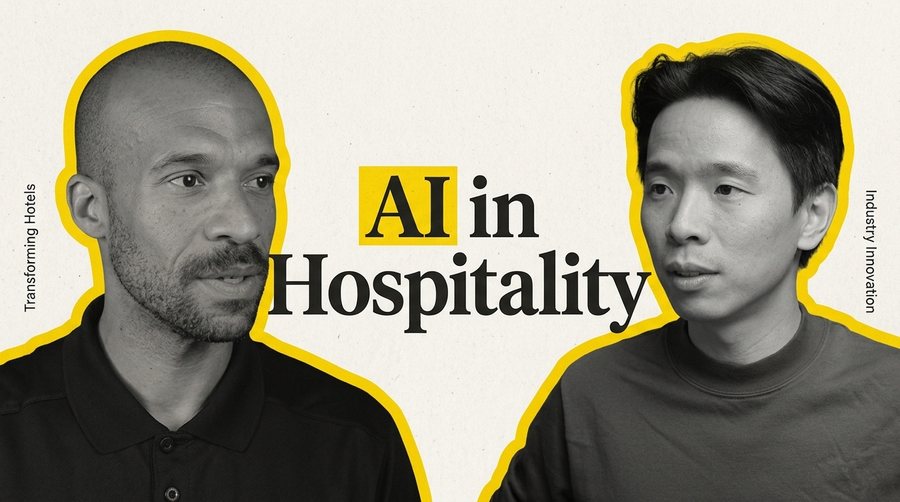
Jonathan Lei Built the AI Answering Your Hotel Phone — Here's What That Taught Him About the Future of Work
Jordan sits down with Jonathan Lei, co-founder of Q Concierge, for a grounded conversation about what happens when cutting-edge AI meets one of the world's most human-centered industries.
Jonathan brings an unusual background — blockchain infrastructure at Ripple, Berkeley data science, and early AI deployments at Domino's — to the historically slow-moving world of hotels and resorts. The conversation covers the real labor crisis quietly reshaping hospitality, what it actually takes to build voice AI that guests trust, and why legacy industries are harder to crack than Silicon Valley typically assumes.
They also zoom out to examine broader implications — the Jevons Paradox, the realistic pace of AGI development, and what neurodivergence might mean for the workforce of tomorrow. This session was recorded on April 7, 2026.
Key Takeaways:
The Hospitality Labor Crisis Is Real — and Quantifiable
This isn't theoretical. Jonathan puts hard numbers on a problem most people outside the industry don't fully appreciate. 69% of U.S. hotels can't fill all their open roles right now. 40% of incoming calls go abandoned. That translates to $250K–$500K in lost booking revenue per property, per year — simply because no one picks up the phone. When you frame AI in that context, the ROI conversation becomes a lot less abstract.
The Results Q Concierge Is Actually Producing
One luxury resort in Puerto Rico is generating $200K per month in AI-handled booking revenue through Q Concierge, with a 15% conversion rate. For context, Jonathan notes that's 30–50% higher than what overseas human call centers typically deliver — and without the language gaps, knowledge gaps, or staffing instability.
What's Under the Hood
Q Concierge answers 100% of incoming calls and integrates directly with a hotel's property management system (PMS) and central reservation system (CRS). The AI handles 78 languages with real-time language detection, asks guests mid-call which language they prefer, and adapts accordingly. The system operates at roughly 95% accuracy, with email summaries of every transaction sent to hotel staff and a human escalation path built in for high-value bookings and frustrated guests.
Data Privacy Isn't an Afterthought
Jonathan walks through the compliance infrastructure — PCI certification for credit card data, GDPR adherence, SOC 2 certification, and monthly penetration testing. Legally, in many states, the AI must disclose itself at the start of every call. Q Concierge builds that transparency in by design, and any guest who doesn't want to speak with AI gets transferred to a human immediately.
Small Teams Are Moving Faster Than Ever
The Q Concierge team is four people. They've raised millions. And with what Jonathan calls "vibe coding" — using tools like Claude, Codex, and Lovable — development cycles that used to take a month now take two to three days. He makes the case that what once took years to reach meaningful revenue can now happen in months, fundamentally compressing the startup timeline in ways Silicon Valley is still adjusting to.
The Jevons Paradox Applied to AI and Labor
Jonathan references the Jevons Paradox — a 19th-century economic observation that when coal-powered engines became more efficient, total coal consumption actually increased because productivity scaled. His read: AI efficiency gains won't shrink the workforce so much as expand economic output. Fewer repetitive tasks for humans means more capacity for creativity, relationship-building, and the kinds of work machines still can't replicate.
Where the Human Element Stays Non-Negotiable
Jonathan is clear that AI won't replace the in-person hospitality experience — especially at the luxury level. His framing is worth sitting with: the goal is to democratize luxury, giving every tier of hotel access to the kind of responsive, personalized service that used to require a dedicated concierge staff. Warmth, creativity, and genuine human connection remain the ceiling AI can approach but not breach.
Jonathan's 5-Year AI Adoption Estimate
When pushed for a number, Jonathan estimates that somewhere around 55–60% of decisions will be delegated to AI within five years — with the caveat that adoption in legacy industries will move considerably slower than the tech community tends to project.
AGI: More Runway Than the Headlines Suggest
Jonathan pushes back on the near-term AGI hype. Building world models for physical environments — the kind needed to power functional robotics — is a fundamentally different and harder problem than predicting language tokens. His take: the people most confident about a 3–5 year AGI timeline are often the least exposed to how slowly industries outside Silicon Valley actually move.
The Neurodivergent Edge Worth Watching
One of the more interesting threads in the conversation — roughly 1 in 5 Americans have some form of neurodivergence. Jonathan's observation is that in an AI-augmented world, the ability to think laterally, multitask across systems, and direct AI agents toward unconventional solutions may be a genuine competitive advantage. The traits that have sometimes made traditional workplaces harder for neurodivergent individuals may be precisely the traits that the next era of work rewards.
#AIinHospitality #FutureOfWork #VoiceAI #StrategicIntelligence #HotelTech





Comments
Sign in or join the 1% who know more than the 99% to read and leave comments.