
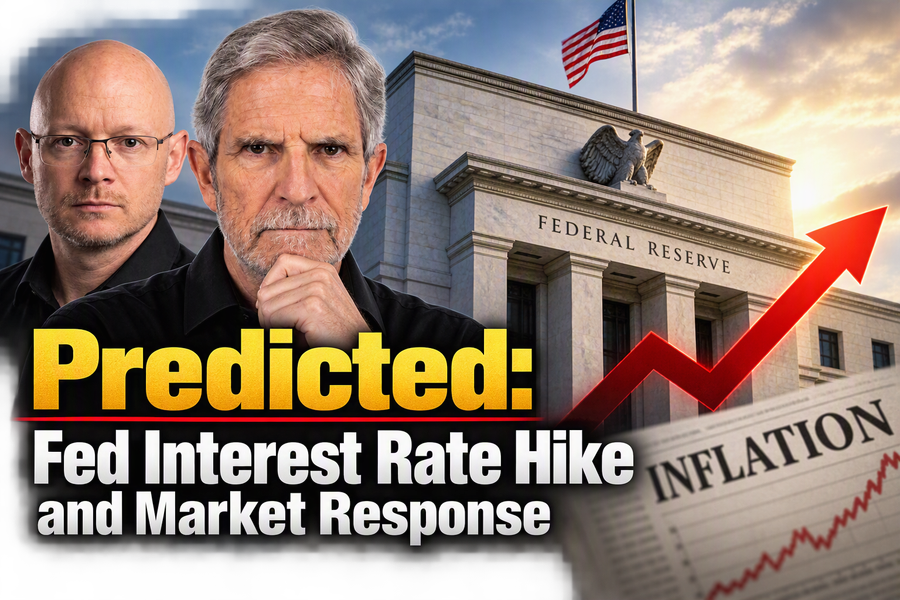
The Fed Hiked for the First Time in Three Years. Our Viewers Described the Drivers in August
In late July, the Future Forecasting Group viewing was given a blind tasking to describe a single target: the Federal Open Market Committee meeting of September 15-16, 2026, and the most important surprise, pattern, or shift in its results. The session record is now scored against the public record.
The Federal Reserve raised its benchmark rate a quarter point to 3.75%-4.00%, the first increase since 2023, in a unanimous 12-0 vote led by Chair Kevin Warsh, and pointed to energy-driven inflation tied to the Iran conflict as a central reason. Rate direction, the energy driver, the committee dynamics, and the geopolitical weight behind the decision were on the team's pages weeks earlier.
Bitcoin's response, the indicator the team flagged as the one to watch, broke from the historical playbook and held its ground through a hawkish hike. Several elements of the session remain unconfirmed, and we name those too.
Full verification notes and the complete session video are below. This session was recorded on August 7, 2026.
Verification Notes
The Tasking (as read on camera in the debrief)
- Target: the FOMC meeting and press conference scheduled for September 16, 2026, hosted by Chair Kevin Warsh at the Marriner S. Eccles Federal Reserve Board building.
- Sub-cue: describe the most important surprise, pattern, or shift in the accompanying results from the meeting, with graphs and charts in the work.
- Analytical indicator named in the debrief: whether bitcoin continues to respond to Federal Reserve policy in the traditional pattern or begins moving independently.
- Team: Edward Riordan, Dick Allgire, Daz Smith, and Nyiam Vendryes, working blind, with financial analysis from Martee Hibbs. Debrief hosted by Dennis Nappe II.
What Actually Happened (public record)
- On August 28, Chair Warsh's Jackson Hole speech reopened the door to a rate increase, calling progress on inflation modest and declining to offer forward guidance (Cambridge Currencies).
- On September 4, August payrolls printed 162,000 against a consensus near 56,000, with unemployment at 4.1%, turning a September hike into the majority expectation (Hitechies).
- On September 16 at 2:00 p.m. ET, the FOMC raised the target range 25 basis points to 3.75%-4.00% in a unanimous 12-0 vote, the first hike since July 2023, stating "Inflation remains elevated" (Federal Reserve, CNBC).
- The updated projections showed the median policy rate at 4.1% through the end of 2027, 16 of 18 participants projecting at least one more hike this year, headline PCE inflation revised up to 3.7%, and the 2% target not reached until 2029. Warsh submitted no dot (Federal Reserve, Reuters).
- At the press conference, Warsh called the economy "strengthening," said he was "hard-pressed to describe broad financial conditions as restrictive," and cited Middle East tension as a factor in the decision (CNBC, The Block).
- Market reaction was orderly: the S&P 500 rose after the announcement, and the 10-year Treasury yield closed near 5.02% before easing, after rising roughly a quarter point since Jackson Hole and a full point from its February low. The 30-year mortgage rate sat at 7.19% (CNBC, Bitcoin News Digest).
- Bitcoin dipped to about $74,962, held $75,000 through the decision, and recovered above $76,000 within hours. CoinDesk described crypto rallying through the Fed's first hike since 2023 as a counterintuitive reaction. Spot bitcoin ETFs saw roughly $746 million in net outflows across September 15-16 (Bitcoin News Digest, CoinDesk, UseTheBitcoin).
- The driver behind the decision was geopolitical: an energy shock following the start of the U.S.-Israeli war with Iran, with Brent near $99, strikes in the Strait of Hormuz in early September, and the Strategic Petroleum Reserve at its lowest level since 1982 (Reuters, Hitechies).
Viewer Data vs. Outcome
Edward Riordan (energy, money creation, rates)
Edward's session centered on money printing, interest rates, and the energy sector, and it produced the strongest single correspondence of the project.
- Confirmed: He described heavy funding flowing into energy, an "energy race," and named the Iran situation as part of an energy war. The Fed's first hike in three years was driven by exactly that: the energy shock from the U.S.-Israeli war with Iran, with Middle East tension cited by Warsh himself.
- Consistent: His rate chart showed movement below and above a central line followed by a higher upward section. The rate path did exactly that: cuts in late 2025, a long hold, then a September increase.
- Consistent: He recorded a strong red downward signal and downward motion during the period in question. Bond prices fell for weeks into the meeting as yields surged, and bitcoin slid from its early-September highs into the decision before rebounding.
- Consistent (context): He tied energy demand to data centers, AI, and crypto. Economists now cite expanded AI investment as a potential inflationary factor in the Fed's calculus.
- Open: His audit theme ("do the books line up," a future AI accounting revealing true value) has no public confirmation tied to this window.
Dick Allgire (the meeting and the plan)
Dick perceived the structure of the event itself with unusual precision.
- Confirmed: One man presenting to a group, a formal central-committee atmosphere, and what he called a rubber stamp of approval. The vote was unanimous, 12-0, under a new chair's press conference.
- Consistent: He drew twenty seated figures and described twelve voting members joined by rotating regional bank presidents. The September projections list nineteen participants, eighteen of whom submitted dots, with the chair submitting none.
- Consistent: He described the event as codified, rehearsed, and war gamed rather than improvised. The decision was 92-96% priced in advance, and markets absorbed it within the hour.
- Not shown at this marker: The precipitating cascade he described, charts gapping sharply up and down, a skim of value during ledger transitions, and managed chaos. Decision-day markets were calm. The team's own framing held that September 16 was a marker in time, not necessarily the event itself.
- Open: His session named two administration economic figures by name as movers behind the levers. Nothing in the public record connects named individuals to a hidden hand in this decision; tariff policy was, however, part of the inflation mix the Fed responded to.
Daz Smith (pressure, decline, release)
Daz read the target as an old, overextended structure under growing strain.
- Consistent: He described an unsustainable structure with problems being ignored. The Fed's own projections now concede inflation above target into 2029, and Reuters framed the hike as an acknowledgment that price pressures are not under control.
- Consistent: He drew pressure building into a release point near the target window. Yields climbed for three weeks into the decision and fell after it, equities rose on the announcement, and bitcoin dipped and recovered within hours.
- Consistent (early): His drawn timeline shows turbulence beginning near the meeting and extending toward 2027-2028. The Fed's dots now show restrictive rates through 2027 with the first cut penciled for 2028.
- Partial: The depth of decline he drew, a spiral that hits the floor, has not appeared in price action to date.
Nyiam Vendryes (the deal and the geopolitical layer)
Nyiam's session carried the heaviest geopolitical signature of the four.
- Consistent: He described an institutional, regulation-heavy, cross-border transaction with a military overlay and tension around controversial partnerships. The FOMC statement itself cites "geopolitical developments" as a source of elevated uncertainty, and the decision was inseparable from an active war and an ongoing tariff conflict.
- Not shown at this marker: A specific controversial deal or treaty involving China or Korea.
Martee Hibbs (analyst chart read at the debrief)
Martee's read came from the charts, not the viewing, but it was stated on the record in the same session.
- Confirmed: "Every single indicator on the bond is negative," meaning rates were anticipated to move up, not down. Six weeks later the Fed hiked for the first time in three years, and the 10-year yield now sits near 5%, its highest in years.
- Confirmed (direction of the anomaly): His helicopter thesis held that at some point risk assets stop obeying the rate signal. Bitcoin held $75,000 and rallied through a hawkish hike, a reaction CoinDesk called counterintuitive. As the debrief itself cautioned, one meeting does not prove permanent decoupling.
- Monitor: His dollar index target of 112-115 by spring remains unconfirmed, with DXY near 99 at the start of September.
Monitor Next
- The October 27-28 and December 8-9 meetings. Sixteen of eighteen officials project another hike this year; a second move converts a one-off into the sequence the session data drew.
- The energy tape: Brent near $101, Hormuz transit volumes, and a Strategic Petroleum Reserve at a 1982 low, and whether the energy impulse fades while the Fed keeps tightening.
- The 10-year yield around 5% and Martee's dollar window of 112-115 by spring.
- Structural plumbing: the strategic bitcoin reserve bill cleared House committee 28-21 on decision day, and the CLARITY Act's post-midterm revival effort is the next legislative marker.
- Daz's 2027-2028 turbulence window against the Fed's first projected cut in 2028.
Disclaimer: Remote viewing session data and market commentary are offered as informational inputs, not certainty, prophecy, or individualized financial advice. Markets carry risk of loss, and past session performance does not guarantee future results. Always do your own research and consult a qualified professional before making financial decisions.


Comments
Sign in or join the 1% who know more than the 99% to read and leave comments.