
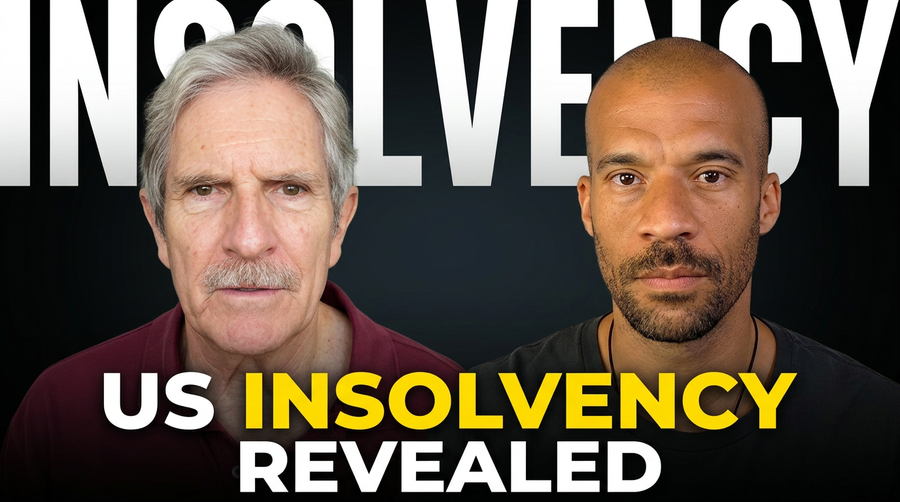
The Treasury Just Confirmed What We've Been Saying for Years — The U.S. Is Insolvent
What happens when the world's largest economy can no longer hide the math? In this session, Dick and Jordan sit down to discuss a quietly released U.S. Treasury report that confirms what FFG analysts have been tracking for years — and what it signals about the broader financial system shift already underway.
They explore the historical context behind large-scale debt cycles, how governments have managed similar inflection points throughout modern history, and why understanding these patterns now could matter more than most people realize.
If you've been sensing that something fundamental is shifting in the global financial landscape, this conversation will give that feeling some structure.
This session was recorded on March 24, 2026.
📌 Key Takeaways & Summary
1. The U.S. Treasury Has Officially Acknowledged Insolvency
This wasn't buried in a footnote — the Treasury released figures showing $47.78 trillion in liabilities against only $6.06 trillion in assets. When you factor in Medicare, Social Security, and other unfunded obligations, the total climbs to $136.2 trillion — approximately 5 times U.S. GDP. Dick and Jordan note that this was released quietly, during a news cycle dominated by other headlines, which they view as a deliberate pattern.
2. Student Loan Debt Is One of the U.S. Government's Largest "Assets"
One of the more striking details: the U.S. government lists $1.8 trillion in student loan debt as an asset on its balance sheet. Jordan points out that this reframes the political conversations around loan forgiveness — when student debt is propping up the government's asset column, writing it off isn't as simple as a campaign promise suggests.
3. Historical Debt Resets Follow Recognizable Patterns
The conversation draws on historical precedent — specifically World War I and II — noting that when sovereign debt loads have become unsustainable in the past, large-scale global disruptions have historically followed. The team isn't predicting a repeat, but they emphasize that understanding historical cycles is essential for strategic positioning before those patterns play out.
4. The BIS, Birth Certificates & the Hidden Architecture of Sovereign Finance
Dick and Jordan discuss the Bank for International Settlements (BIS) and the largely unknown financial architecture underlying sovereign nations — including how human productivity and population are factored into international monetary settlements. While unconventional, they frame this as context for understanding why immigration policy, debt ceilings, and global monetary shifts are more interconnected than surface-level political coverage suggests.
5. The Transition to a Tokenized, Digital Financial System Is Accelerating
Both analysts point to the tokenization of assets as the likely destination of the current financial restructuring. Their long-standing thesis: the legacy system needs to be wound down before a distributed ledger-based replacement can be fully implemented. The timing of current political and economic events, they argue, is consistent with that transition being in its active phase.
6. Information Bubbles Are Engineered — and Awareness Is the Edge
One of the more thoughtful moments in the conversation: Jordan reflects on how every major ideological tribe — from QAnon to progressive media consumers — has had a "bubble" constructed around them. The value isn't in which bubble you're in, he argues, it's in recognizing the architecture of the bubbles themselves and stepping back to see the macro picture. "Free your mind and look from a more macro level" — that's the practical takeaway here.
7. U.S. Government Acquires Alien.gov and Aliens.gov Domains
In a lighter but notable sidebar, Dick flags that the U.S. government has acquired both alien.gov and aliens.gov — a verified detail that Jordan frames as consistent with what they've long described as "the last card in the deck." Whether geopolitical theater or something more substantive, it's the kind of leading indicator worth watching.
#FinancialIntelligence #USDebt #TokenizedEconomy #FutureForecasting #StrategicPositioning
💡 This content is for intelligence and awareness purposes only. FFG provides pattern-based analysis, not financial advice. Remote viewing carries an approximate 64% accuracy rate using military-grade double-blind protocols. Always consult a licensed financial advisor before making investment decisions.



Comments
Sign in or become a Future Forecasters Group member to read and leave comments.