
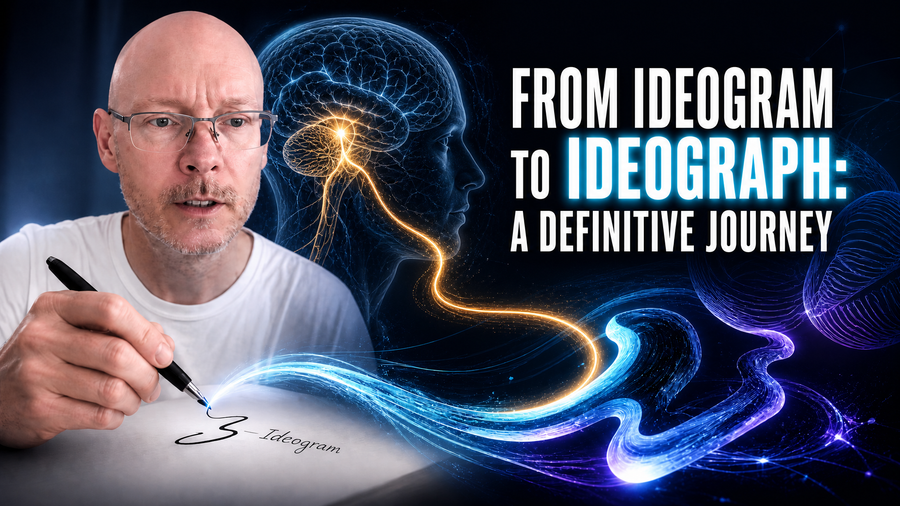
Edward Lesson for the Day: Ideogram vs. Ideograph - One Letter That Changes How You Remote View
The first seconds of a remote viewing session set the terms for everything that follows. Before the sketches, before the descriptors, before any data worth trusting, the viewer's nervous system makes its opening move on paper.
Standard training calls that mark an ideogram, and the Stargate manual has defined it the same way for decades. Edward Riordan has stopped using the word. His replacement, ideograph, looks like a one-letter change. It carries an entire theory of how signal contact works.
Built on the Greek distinction between gram, the finished mark, and graph, the act of drawing it, the term reframes the opening of a session as a subjective event to experience: a dimensional sensation moving through proprioceptive channels. The finished mark stops being the object of analysis. Mountain, water, structure: the classic labels can wait, or never arrive at all.
In this lesson, Edward argues the point against an AI that kept insisting the two words are interchangeable, walks through the Stargate stages of ideogram analysis, and demonstrates his own ideograph process live, including the anatomy he believes turns a mark into a sensation.
This session was recorded on August 12, 2026. Full notes and the session video are below for members.
Not a Member? Join the team




Comments
Sign in or join the 1% who know more than the 99% to read and leave comments.