
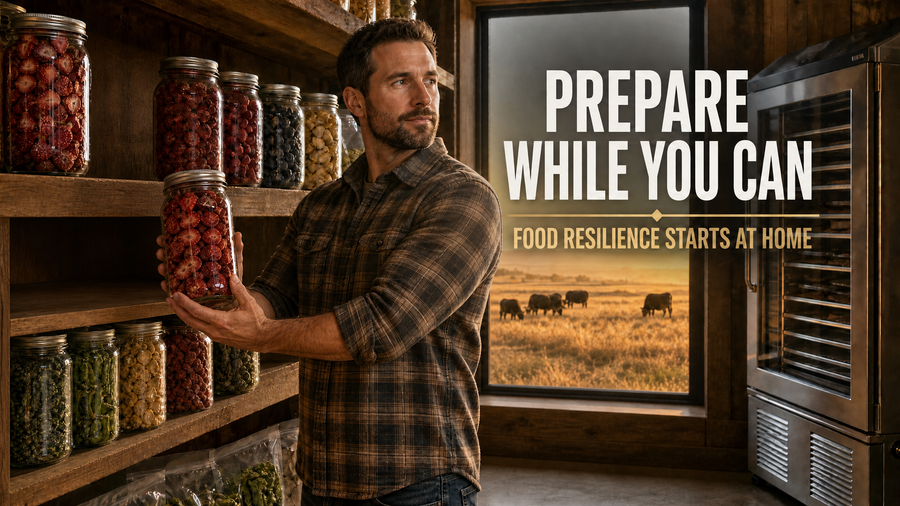
Food Prices Aren't Relaxing... They're Finding a New Floor: Prepare Now.
If you've watched grocery prices lately, you've probably noticed they don't relax. They find a new floor, then climb again.
USDA's July outlook confirms it isn't perception. The department raised its 2026 steer price forecast for the second time this summer, now projecting continued strength into 2027.
The reason isn't demand weakness. It's supply. Nearly half the U.S. cattle inventory now sits in drought-affected regions, more than double the share from a year ago. Herd rebuilding, the thing that would eventually bring prices back down, keeps getting pushed further out.
This pattern isn't limited to beef. The same feed and water pressure touches produce yields, orchard fruit, and grain. When the input side tightens, the output side eventually shows it on a shelf tag.
We've been tracking this pattern for a reason. It's part of why the FFG group buy with Stay Fresh exists, and why we fought to get the best freeze dryer deal on the market for our members.
Here's a deeper analysis:
What changed
USDA's July Livestock, Dairy and Poultry Outlook raised the 2026 steer price forecast to $251.10 per hundredweight and the 2027 forecast to $254.25, per RFD News. USDA now puts 46% of U.S. cattle inventory in drought-affected areas, up from 16% a year earlier. Separately, Terrain's senior protein analyst Dave Weaber notes more than three-quarters of the beef cow herd is currently under drought conditions, and expects herd expansion into 2027 to be small "if it occurs at all."
Why it matters
Feed scarcity forces ranchers into two bad options: cull now at depressed prices, or hold and pay up for scarce feed. Either path removes breeding stock from the system. That is a multi-year lag before supply normalizes, not a seasonal blip. USDA also flagged New World screwworm activity at the Texas-Mexico border complicating cattle movement and delaying the reopening of Mexican live cattle trade, one more friction point on the supply side.
Leverage
The same drought conditions pressuring cattle feed also touch irrigation-dependent produce, orchard fruit, and grain yields. When yield falls and demand doesn't, the same volume of buyers chase fewer tons. Buying and preserving food at today's prices is a way of converting a known cost into a fixed one, ahead of a supply cycle that keeps extending rather than resolving.
Risks / what could soften this read
A strong El Niño pattern later this year could improve pasture conditions into 2027. USDA and Terrain both note this arrives too late to help most current operations, but a wetter fall-winter would blunt the multi-year severity of the setup.
Options
This is the backdrop behind the FFG Stay Fresh group buy. Locking in current retail pricing on a freeze dryer, then preserving produce and protein bought at today's cost, is a direct response to a food system where the floor keeps moving up rather than down.
Mega Package — $4,895 (retail value $5,914)
Large Package — $3,980 (retail value $4,810)
Standard Package — $3,150 (retail value $3,830)
The current member pricing window is only available for a limited time. More pressing is the fact that harvest time is rapidly approaching, and the lead time after ordering a new Stay Fresh unit runs approximately six weeks.
Monitor next
Friday's USDA Cattle-on-Feed report, and whether El Niño's late-summer arrival shows up in pasture condition data before winter.
Members can access the lowest prices in the market here:
 Jordan Finneseth
Not a Member?
This analysis is informational, drawn from public USDA and industry agricultural data. It is not financial advice, and market and agricultural forecasts carry uncertainty. Evaluate any purchase decision against your own household needs and budget.





Comments
Sign in or join the 1% who know more than the 99% to read and leave comments.