
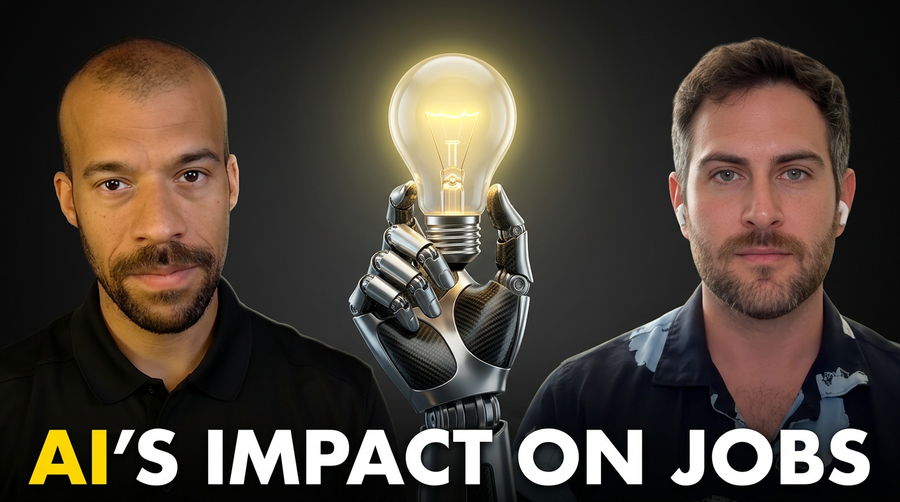
Interview: While the World Debates Whether AI Takes Jobs, the Builders Are Already Winning
What happens when someone who has personally hired thousands of people, built and sold a thriving consumer brand, and now runs one of the largest AI resume platforms in the country sits down to talk honestly about where the job market is headed? This conversation.
Colin McIntosh — executive tech recruiter at Riviera Partners and founder of Sheets Resume — brings a rare dual vantage point to a discussion that ranges from the deeply practical to the genuinely philosophical.
Where are the real opportunities right now? Which industries are actually at risk? And underneath all of it, what does it mean to build something meaningful in a world increasingly shaped by algorithms?
If you've sensed that something fundamental is shifting in how we work and live, this episode gives that feeling a framework.
This session was recorded on April 3, 2026.
Key Takeaways
The AI Hiring Freeze Is Real — and It's Already Showing Up
Colin is clear: mass layoffs haven't fully materialized yet, but the hiring freeze is active and measurable. Companies are quietly doing more with less, holding headcount steady while they figure out how far AI can carry the load. The uncertainty compound — trade tensions, macro volatility, and AI integration timelines — is making employers cautious in a way that's showing up directly in job seekers' experience.
The Average Job Hunt: 5 Months, 200 Applications
That's not a headline statistic — that's the current lived reality Colin and his team see every day through Sheets Resume, which processes 20,000–30,000 resumes every single month. The volume of applications required to land a role has made standing out structurally harder, and most people are still optimizing the wrong things.
The Solopreneur Window Is Wide Open — Right Now
Colin has launched four or five full products in about a month using Claude Code, including a Shopify face-swap app, his wife's business site (now the top Google result for "fire dancer Miami"), his mom's acupuncture practice, and a local painter's website. His estimate for what that would have cost even two years ago: $30,000–$50,000 through an agency, and upward of $200,000 for a high-converting e-commerce build. Today, the barrier is almost entirely conceptual, not technical.
AI Transformation Agencies Are Becoming a Real Industry
He's already seeing it in his network. Firms are emerging that specialize in helping businesses navigate AI integration across workflows — from customer service to logistics to engineering. And because these disciplines are one to three years old at most, nobody has a meaningful experience advantage yet. The person who moves now has as legitimate a claim to expertise as anyone.
Coding as a Career: The Honest Assessment
Colin recruits CTOs for a living. The engineers he talks to — serious, highly credentialed people — are already grieving a shift they didn't expect to happen this fast. His read: the average person using AI coding tools today has roughly equivalent output capability to 90% of working software developers. That's not a future projection — it's his current, observed reality. He notes that writing, by contrast, remains genuinely hard to replicate well, because the dataset of excellent human writing is small while the dataset of excellent code is enormous.
The Jobs at Risk — and the Timeline
The largest U.S. employers right now are in driving, retail, logistics, warehousing, and food service — sectors not yet automated at scale. But Colin knows people actively building AI solutions for each of those verticals. His framing: top performers in those fields will get superpowers. Everyone operating in the margins faces a harder road ahead, and the timeline is compressing.
What Makes Us Human in an Automated World
The conversation goes somewhere most business podcasts don't. Colin reflects on consciousness research suggesting that consciousness is more tied to the body than the brain — that intuition, gut, emotion, and physical experience are part of what makes human cognition irreplaceable. Jordan introduces the remote viewing work FFG does as another data point: humans accessing information across time and space through structured protocol, a capability no current AI can replicate. Both agree that the question of what's distinctly human is no longer theoretical.
Help Other People — and the Economics Follow
Colin's most grounded advice after building, selling, and rebuilding: when entrepreneurs exit and feel lost, the answer is almost always to direct that energy toward helping others. Altruism as a calling. He gives away Sheets Resume's AI tools to anyone who genuinely can't afford them — and the emails he gets back are the ones that actually mean something to him.
#FutureOfWork #AIOpportunity #SolopreneurLife #StrategicIntelligence #BullrunBunker



Comments
Sign in or join the 1% who know more than the 99% to read and leave comments.