
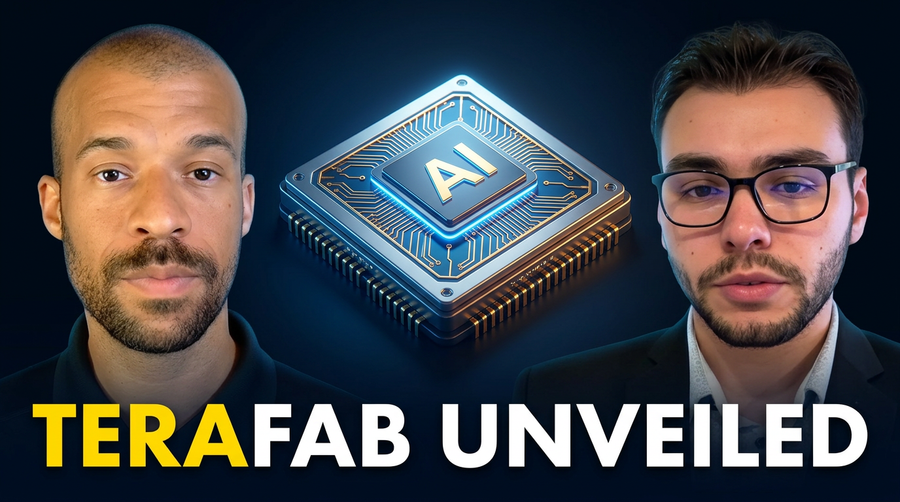
Interview: The $25 Billion Chip Facility That Could Reshape AI, Robotics, and Space
When Elon Musk announced Terafab — a joint venture between Tesla, SpaceX, and xAI — most coverage stopped at the headline. This conversation goes deeper.
AI consultant Noah Kenney, founder of Digital 520 and former Chief Scientist at an AI R&D lab, walks through the real mechanics behind the announcement: the supply chain constraints driving it, the energy infrastructure required to make it viable, and the investment angles most analysts are still sleeping on.
From the global chip market and AGI trajectory to robotics, regulatory dynamics, and what smart money is quietly watching, this is the kind of layered, strategic conversation that puts you ahead of the news cycle — not behind it. If you want context that actually helps you position, start here.
This session was recorded on April 2, 2026.
Key Takeaways:
The Announcement Itself
- Terafab is a proposed $25 billion joint venture between Tesla, xAI, and SpaceX — Elon Musk's three primary companies — designed to create a fully vertically integrated chip manufacturing, memory, and packaging facility, all under one roof. This architecture has never been attempted at this scale.
- The facility is targeting 1 terawatt of annual computing power — roughly 50x the current global AI chip industry's output and approximately 70% of TSMC's current production capacity.
- 80% of output is earmarked for SpaceX's orbital AI data centers (datacenters in space). The remaining 20% feeds Tesla's autonomous vehicles, the Optimus humanoid robot line, and next-gen inference chips.
- Long-term cost projections could reach $5 trillion — the $25B announcement is widely seen as a starting investment, not a final price tag. Noah noted that Oracle recently took on $58 billion in debt just to build out AI infrastructure, which puts the Terafab figure in perspective.
The Energy Problem
- The facility's energy requirements are one of its biggest near-term constraints. Noah estimates 12–16 months just to meet the energy infrastructure demands required to power a plant of this size — before a single chip comes off the line.
- Musk's proposed solution: harness solar energy in space, where you eliminate day/night cycles, seasonality, and heat dissipation challenges. He has reportedly filed with the federal government for permitting to launch approximately 100,000 units into space for this purpose.
- Heat dissipation from chip production is a significant engineering challenge on Earth. In space, that energy can be radiated back into the solar system — a key advantage Musk is banking on.
- The U.S. energy grid, as it stands today, cannot support a rapid-scale buildout of this nature. Iterative improvements alone won't close the gap — a more fundamental energy breakthrough is likely required.
What This Means for TSMC and Samsung
- TSMC currently controls roughly 70% of the advanced chip market. Samsung is the other major player. Together, they supply chips to companies like Nvidia, Amazon, Tesla, and xAI.
- Near-term stock impact on TSMC: minimal. Terafab isn't built yet, and re-engineering an entire supply chain doesn't happen in quarters — it happens in years.
- Long-term impact: Tesla, xAI, and SpaceX will eventually stop being customers of TSMC and Samsung. That's a significant customer loss, and it will have a tangible impact when it materializes.
- The current market dynamic isn't winner-take-all. TSMC and Samsung are both operating at capacity and selling out. The competitive pressure is on raw materials and labor, not price.
The Supply Chain Reality
- The primary machine required for chip manufacturing is produced by a single company internationally, with a multi-year wait list. That's how constrained the current infrastructure is.
- Raw material sourcing — including silicon wafers — is largely international, adding another layer of supply chain complexity.
- Skilled labor is a critical bottleneck. Lithography experts are in severe shortage, and very few U.S. educational programs are training people for these roles. Musk may need to build his own pipeline — potentially recruiting directly from high school and training in-house.
Investment Angles Worth Watching(Note: Not financial advice — for informational purposes only)
- Austin, Texas real estate: The facility requires several thousand acres. Once a land purchase is confirmed, surrounding housing and commercial real estate in that corridor could see significant activity.
- Energy sector: Providers in and around the Austin area stand to benefit from the facility's massive energy consumption — particularly companies working on new forms of energy production and distribution.
- Raw materials: While some of the raw material demand may simply shift from TSMC to Terafab rather than grow net-new, overall AI chip demand is expanding. Materials plays remain relevant.
- Tesla (long-term): If Terafab drives chip costs down and increases access, Tesla's vehicle production volume and profit margins on Optimus robots could surge — a legitimate investment consideration on a multi-year horizon.
- China: Watch China closely for robotics and chip manufacturing advances. They have more direct access to certain supply chain components and are aggressively pursuing self-driving and humanoid robot development.
AGI and the Bigger Picture
- AGI (Artificial General Intelligence) has no universally agreed-upon definition, which means the question of whether we've "achieved it" is partly definitional. Noah highlighted that some argue current models like ChatGPT and Claude already qualify; others say we're still far off.
- What's clear: chips are the primary constraint to expanding AI capabilities. More powerful, accessible chips will directly accelerate the development trajectory — wherever that leads.
- AI still lacks creativity, genuine emotional experience, and sensory awareness in the human sense. Some argue those limitations mean true AGI is structurally impossible. Others see it as a matter of compute and time.
Robotics: The Critical Second Step
- Noah mapped out a cycle worth internalizing: robots building chips → chips enabling smarter robots → robots helping build more chips. That loop is central to how Musk intends to scale.
- Custom manufacturing robotics will likely be deployed in the Terafab facility long before humanoid robots like Optimus are fully mature. Two parallel tracks, converging over time.
- China and Japan are leading globally in humanoid robotics development — a trend that will accelerate significantly over the next 5–10 years.
Regulation and Governance
- There is currently no specific regulatory framework for a project like Terafab. The U.S. government has historically taken a reactive, hands-off approach to AI infrastructure — issuing executive orders after the fact rather than establishing proactive legislation.
- The Anthropic vs. Department of Defense case is worth following: a federal judge's preliminary ruling found that the DoD violated Anthropic's First Amendment and due process rights by blacklisting them after Anthropic declined to allow certain military applications of their technology.
- The EU AI Act is being revised and amended. Its definitions (built on OECD frameworks) are being adopted by over 100 countries — including the U.S. indirectly. This regulatory momentum will shape how projects like Terafab are eventually governed.
- States like Texas are actively incentivizing Musk to build there through tax incentives — while states like California remain unlikely candidates due to regulatory density.
Timeline Expectations
- First chips from Terafab: years away, not months. Realistically, energy infrastructure alone takes 12–16 months. Factor in permitting, land acquisition, facility construction, labor sourcing, and supply chain buildout — you're looking at a multi-year ramp.
- This is generational infrastructure, in the same category as the U.S. highway system. The people who benefit most from what's built now may be the next generation — not the current one.
#Terafab #AIChips #FutureForecasting #StrategicIntelligence #ElonMusk




Comments
Sign in or join the 1% who know more than the 99% to read and leave comments.