
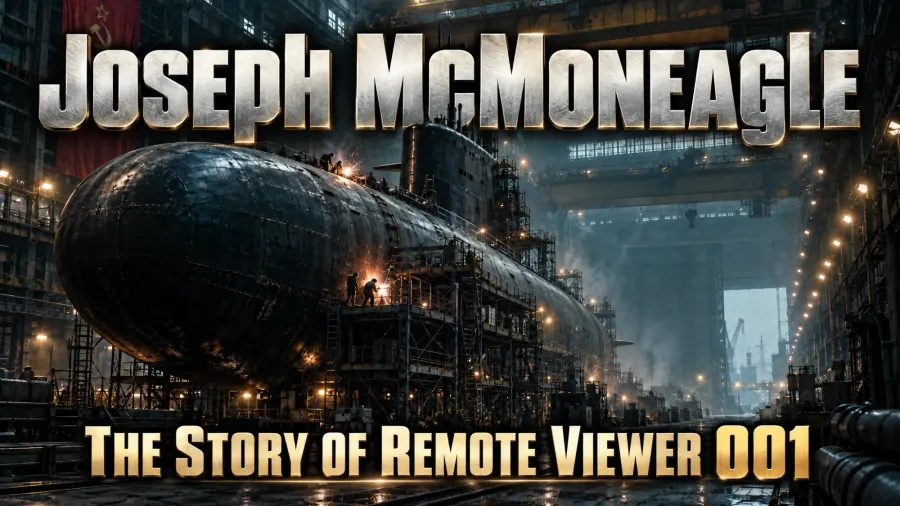
Joseph McMoneagle and the Story of Remote Viewer 001
In 1979, Western intelligence had a problem it could not see. Somewhere inside the Soviet Union, something was being built, and no satellite had found it yet.
That year, Army warrant officer Joseph McMoneagle, designated Remote Viewer 001 in the U.S. government's remote viewing unit at Fort Meade, was given a tasking with no prior information: describe a facility on the other side of the world. What he produced was a working picture of the Soviet shipyard at Severodvinsk, including a submarine under construction larger than anything in the Western inventory, with a double hull and two rows of missile tubes. Roughly 114 days later, satellite imagery confirmed a new boat rolling out of that exact yard, later known to NATO as the Typhoon class and to the Soviets as Project 941 Akula.
Nyiam Vendryes of the Future Forecasting Group walks through the Severodvinsk session, the Fort Meade unit's operational process, and the 1984 Legion of Merit awarded for work that stayed classified for years. For anyone evaluating remote viewing as a discipline rather than a curiosity, this case is the evidentiary benchmark.
Key Takeaways:
This presentation is a historical case study built around the career of Joseph McMoneagle and the 1979 tasking that became the most cited verification case to come out of the U.S. government's remote viewing program.
The Viewer: Joseph McMoneagle
- Army warrant officer assigned to the remote viewing unit at Fort Meade
- Designated Remote Viewer 001, the first operational viewer in the program later known publicly as Project Stargate
- Background segment covers his military career and the establishment of the Fort Meade unit (0:36 to 1:33)
How the Unit Worked
- Operational process segment (1:33 to 2:09): viewers worked taskings blind, with no prior information about the target
- The unit's structure was built so results could be checked against ground truth rather than taken on faith
The Severodvinsk Session (1979)
Session output (2:37 to 4:45):
- McMoneagle was asked to describe a facility on the other side of the world, with no front-loaded information
- He described a Soviet submarine construction yard at Severodvinsk
- He reported a submarine under construction that was larger than any known class
- He described a double-hulled design with two rows of missile tubes
Verification timeline:
- Session completed in 1979 with the above descriptors on record
- Roughly 114 days later, satellite imagery confirmed a new submarine emerging from the Severodvinsk yard
- NATO designated the boat the Typhoon class; the Soviet designation was Project 941 Akula
- The confirmed specifications matched the session data: size beyond any prior class, double hull, dual missile-tube rows
Recognition and Legacy
- McMoneagle received the Legion of Merit in 1984 for intelligence work that remained classified at the time
- Closing segment (4:45 to 6:43) covers his retirement and the continued application of the same methods today
- Nyiam's introduction to the Future Forecasting Group (2:09 to 2:37) connects this lineage of disciplined, verifiable remote viewing to the team's current work
Why It Matters for the Craft
The Severodvinsk case holds every element a skeptic is entitled to demand: blind tasking, recorded output, a specific falsifiable claim, and independent confirmation by hard technical means. It remains the clearest demonstration that the method, run under protocol, can produce information about things no sensor had yet found.
Disclaimer: Remote viewing material is an informational input for study and evaluation, offered as evidence of method rather than certainty or prophecy. Historical cases are presented as documented record, not as a guarantee of results in any current application. Weigh all intelligence inputs against your own judgment and primary sources.




Comments
Sign in or join the 1% who know more than the 99% to read and leave comments.