
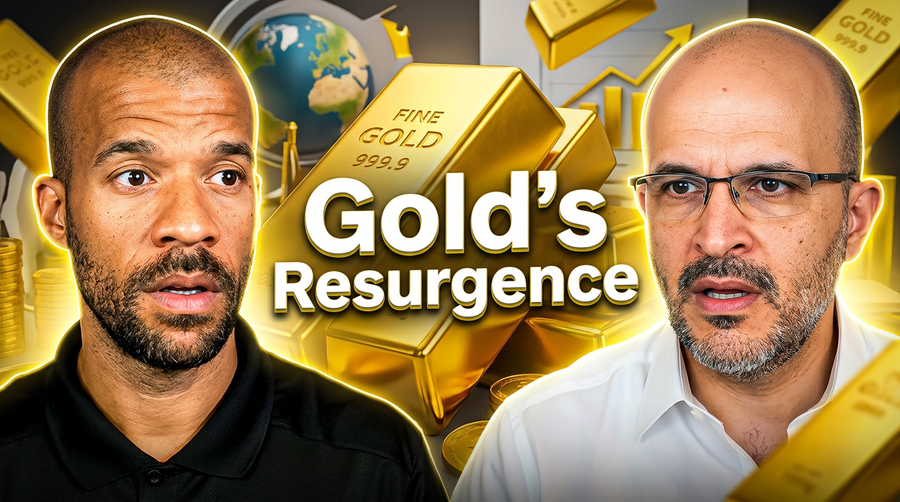
The $2 Trillion Shift: Why the Smart Money Is Already in Gold Before Retail Catches On
Gold has officially overtaken U.S. Treasuries as the world's largest foreign reserve asset — and most investors haven't adjusted their portfolios yet.
In this Bullrun Bunker interview, we sit down with Luciano Duque, CEO of C3 Bullion, to unpack the structural forces reshaping how institutions, governments, and everyday investors are approaching gold in 2026.
We dig into the Basel III regulatory framework, the growing conversation around gold revaluation, and why the allocation gap between U.S. investors and their global counterparts may represent one of the most significant wealth positioning opportunities in a generation.
Luciano also shares how C3 Bullion is bridging the space between gold mine production and portfolio income — and what the future of tokenized gold could look like for everyday investors.
This session was recorded on April 3, 2026.
Key Takeaways
Gold's Historic Run — and Where It May Be Headed
- Gold surged over 60% in 2025 — its strongest annual performance since 1979 — breaking through all-time highs and crossing $4,000/oz by early 2026.
- As of the recording, spot gold was trading around $4,782/oz and continuing to climb.
- J.P. Morgan has set a target of $5,000/oz by Q4 2026.
- Some analysts believe a formal U.S. gold revaluation could push prices toward $10,000/oz, based on unlocking an estimated $900 billion to $1.3 trillion in balance sheet value overnight.
The Reserve Asset Shift Almost Nobody Noticed
- Gold has officially surpassed U.S. Treasuries as the world's largest foreign reserve asset.
- Central banks are purchasing at a rate of 900–1,000 tons per year with no signs of slowing.
- The U.S. government still officially values its gold reserves at $42.22/oz — a number frozen in time since 1973. That gap between book value and market price is increasingly hard to ignore.
The Allocation Gap — and Why It Matters
- European investors hold approximately 5.7% of their portfolios in gold. Asian investors: around 7%. U.S. investors: just 0.5%.
- With an estimated $100 trillion in U.S.-based portfolios, even a move from 0.5% to 2.5% allocation represents $2 trillion flowing into gold — more than the market can absorb quickly without significant price impact.
- Luciano's view: this rebalancing has already started and is likely a multi-year trend, not a short-term spike.
Basel III — The Regulatory Tailwind Most Investors Are Overlooking
- Under Basel III, gold has been classified as a Tier 1 asset, giving large financial institutions a regulatory framework — and incentive — to hold it. This is distinct from war scares or inflation fears. The structural demand is now embedded in the system.
The C3 Bullion Model — Earning Yield on Gold
- C3 Bullion operates by extending private credit to gold mines in Latin America (where all-in production costs run approximately $1,400/oz), receiving repayment in physical gold at a discount.
- That physical gold is vaulted — never rehypothecated — and investors receive allocations that grow in quantity over time (e.g., 1 oz in Year 1, potentially 2–4 oz by Year 4), independent of price fluctuations.
- The tokenized framework is already built into the company's structure; rollout is a future phase.
- Because the gold is received rather than purchased and never sold, no taxable event is created — opening the door to strategies like collateralized lending against the asset.
Portfolio Strategy Recommendations from Luciano
- Core gold position: 5–10% of portfolio (up to 15% depending on age and risk profile). Build it. Leave it. Stop checking the price daily.
- Silver: More speculative upside potential due to gold-silver ratio compression, but lacks the regulatory tailwinds gold currently has. Suggested as a trading allocation (~2.5%) separate from the core gold position.
- Bitcoin: Trades more like the S&P 500 and should be viewed separately — both can coexist in a portfolio, with weighting based on age and risk tolerance.
- Avoid emotional trading in gold. The common mistake is treating a long-term monetary asset like a daily trading instrument. The trend is structural and multi-year — react accordingly.
Gold as a Monetary Asset — The Bigger Picture
- Luciano's framing: gold is not an investment in the traditional sense. For retail investors, it functions as portfolio insurance. For institutions, it's a reserve tool. For governments, it's a strategic geopolitical asset — one that can be used, reused, and leveraged indefinitely, unlike consumable commodities like oil or silver used in manufacturing.
- A full gold-backed currency is unlikely (governments need monetary flexibility), but gold-collateralized debt issuance is increasingly plausible — and already happening in some form.
- The conversation around Fort Knox auditing and U.S. gold revaluation is gaining traction. Whether or not it materializes near-term, the broader signal is the same: gold is being repositioned at the highest levels of the global financial system.
#GoldInvesting #WealthProtection #MonetaryReset #PreciousMetals #StrategicIntelligence





Comments
Sign in or join the 1% who know more than the 99% to read and leave comments.