
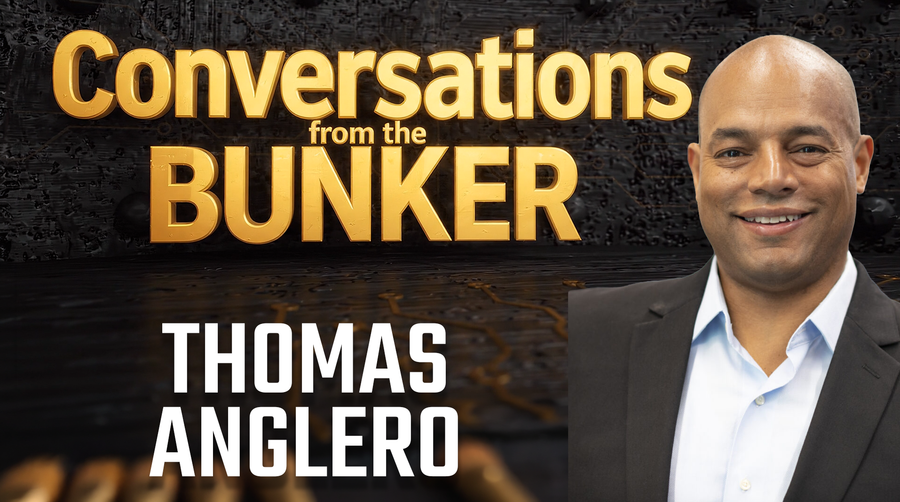
The Hive Mind and the Front Porch: Humanoid Robotics, Distributed Learning, and the Texture of the Coming Transition
Recorded in April 2026, this conversation takes a long-range, pattern-oriented view of the AI and robotics transition.
Thomas Anglero, a Strategic AI Advisor, discusses how his background in engineering, combined with the field of AI, has led to a set of structural observations: that humanoid robot pricing is compressing faster than most adoption models anticipate, that distributed hive-mind learning architectures will accelerate capability gains non-linearly, and that the current period of social and economic disruption follows a recognizable pre-inflection pattern.
The discussion covers AI agent swarms as a problem-solving architecture, edge AI as a privacy-preserving alternative to cloud-dependent systems, the emerging greenfield industries around robot repair and parts distribution, and the long-range case for blockchain and crypto as the data ownership layer of the coming economy.
Significant tension remains unresolved around generational divergence in privacy expectations, the pace of job displacement relative to new industry formation, and whether the optimistic long-range scenario accounts adequately for concentrated misuse of these systems.
Key Themes
- Humanoid robotics pricing compression and the adoption curve: from $50,000 to sub-$4,000 in a compressed timeframe, with further decline projected
- Hive-mind learning architecture: how real-world robot deployment generates training data that improves all units simultaneously, accelerating capability gains
- AI agent swarms as a distributed problem-solving model: instantiated expert roles, synthesized from the full corpus of human knowledge, assembled on demand
- Edge AI vs. cloud-dependent AI: the privacy and sovereignty case for local model deployment
- Greenfield industries forming around the robot economy: repair, parts distribution, recycling — sectors with no established incumbents
- Blockchain and crypto as the data ownership and monetization layer for the AI-driven economy
- The generational divergence thesis: older cohorts experience the transition as disruption; younger cohorts experience it as baseline reality
Systemic Insights
- The robotics capability curve is not primarily a hardware story — it is an AI story. The brain of the robot is the binding constraint, and that constraint is loosening rapidly
- Distributed hive-mind learning means that consumer adoption of first-generation robots is itself a training mechanism for subsequent generations — the adoption curve and the capability curve are coupled
- The pre-internet analogy is deployed as a structural frame: the inability to foresee new job categories and industries from within a prior technological paradigm is a recurring pattern, not a unique feature of the current moment
- The data ownership problem — that individuals currently generate economic value from their behavioral data without compensation — is framed as a structural misalignment that blockchain-based systems are positioned to correct
- The "dip before the rocket" pattern is applied simultaneously to crypto markets, humanoid robotics adoption, and broader social cohesion — suggesting a convergent inflection point rather than isolated sector dynamics
Open Questions Raised
- How does the pace of new industry formation (robot repair, distribution, recycling) compare to the pace of job displacement in sectors exposed to automation — and what is the realistic transition timeline for affected workers?
- If hive-mind learning architectures aggregate behavioral and environmental data from consumer robots, what are the data governance and privacy implications at scale?
- The optimistic long-range scenario assumes that the benefits of AI and robotics distribute broadly — what structural mechanisms would need to be in place to prevent concentration of those gains?
- As edge AI matures and local model deployment becomes viable for consumers, how does the competitive dynamic between privacy-preserving local systems and capability-rich cloud systems resolve?
- The generational divergence in privacy expectations is noted but not resolved: does the Gen Z baseline of low privacy expectation represent an adaptation, or a structural vulnerability in the coming data economy?




Comments
Sign in or join the 1% who know more than the 99% to read and leave comments.