
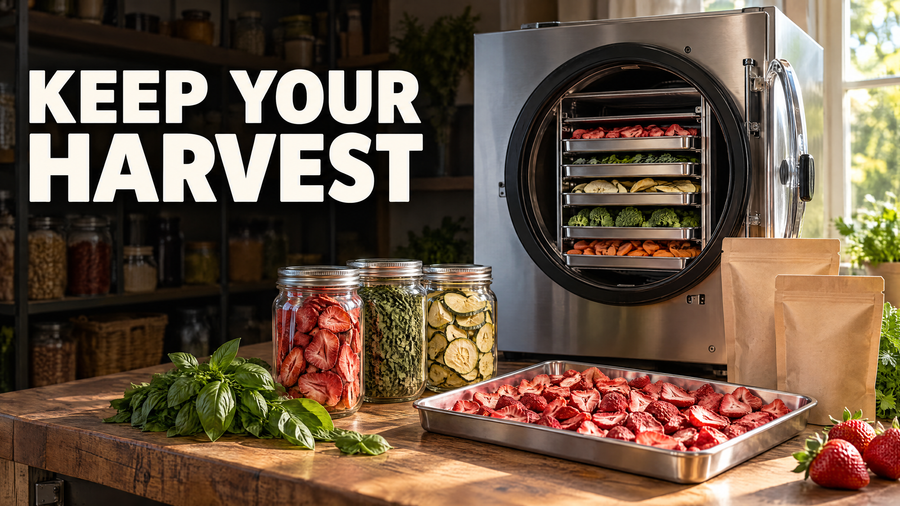
The Harvest You Keep: Inside FFG's Working Session With Stay Fresh
Most food storage plans fail at the same point: the food you actually want to eat later is the food you grew, raised, and cooked yourself.
A recent Future Forecasting Group member webinar put that problem on the table with the team from Stay Fresh, a freeze dryer manufacturer whose machines are built to industrial specification, alongside FFG members who run them every day.
The discussion covered a decade of farm-scale freeze drying lessons, from eggs and bone broth to herbal preparations and complete meals packed for forestry work and emergency response. Members compared notes on what separates equipment that lasts from equipment that gets replaced, the maintenance habits that protect every batch, and why knowing exactly where your food comes from is becoming a planning variable in its own right.
For anyone weighing food security, harvest preservation, or self-reliance decisions, this session offers rare first-hand signal from people who depend on the process daily. Full notes and the complete session video are below for members.
This session was recorded on October 9, 2026.
Update Notes
The FFG leadership joined Stay Fresh representative Cole and FFG members Kyle Hovey and his wife Angela, Margaret, and Georgiana to trade real-world freeze-drying experience: what to buy, how to run it, and how to keep it running.
A decade of freeze drying: Michael's field lessons
- Farming background; before 2013, the operation relied on pickling and canning, which failed to solve winter stability at scale
- Freeze-dried legumes, meats, eggs, and milk to bridge the gap when 60 laying hens cycle out of production
- Notes freeze drying served European military rationing for decades without reaching private users there
- Started in 2013 on Harvest Right units; painful European voltage conversion, no industrial-grade pump, and a roughly $3,000 pump upgrade quote during COVID pushed the switch to Stay Fresh
- Runs two Stay Fresh units near-continuously on the Paraguay farm, powered by wind and solar, reporting zero issues
- Packs freeze-dried pouches for forestry and tractor work; shared them with firefighters and civil emergency response during overnight rescue operations
- Recounts passing on discounted Mountain House batches from 2011 to 2013 after connecting them to elevated post-Fukushima background radiation; provenance is a growing variable
- Moving toward hydroponics under roof for controlled air, water, and soil before harvest and freeze-drying
- Eggshell protocol: dry, freeze dry, grind, then return the calcium to animal fodder and human food
- Fat is the constraint: fats go rancid, so keep fat content low in prepared meals and consume higher-fat batches quickly; commercial producers separate oils into pouches for the same reason
Kyle and Angela: research-first purchase, daily use
- Roughly 1.5 years of research before buying, including Facebook groups and teardown videos (Donald's Freeze Dryer Support and Reviews) comparing Stay Fresh, Harvest Right, and Blue Alpine
- What sold them: removable panels, organized wiring, standard fittings, and serviceable components versus blown-in insulation and proprietary connections
- Chose the five-tray medium unit with extra trays, vacuum hose, and the commercial pump; running since about May 25 (year not stated in session)
- Purchased on a military discount shortly before the FFG group discount rolled out, which they noted was slightly better
- Running smoked salsa, hydroponic basil, a three-meals-per-chicken rotation, freeze-dried bone broth, and organic MRE-style meals (lasagna, goulash) they prefer over store-bought Peak Refuel
- Freeze-drying eggs at peak production; frames the machine as insurance for the family, with food waste largely eliminated
Margaret: from hesitation to daily runs
- FFG member for roughly two years; held off on price and grew wary after seeing large numbers of a competing brand resold second-hand
- FFG's diligence process supplied the confidence to buy; unit has run daily for about a month and a half in a two-person household with a garden
- First rice batch in progress; freeze-dried lemon balm powdered for homemade ice cream; surplus kale and lamb's quarters dried and blended for soups and stews
Georgiana: new owner, pre-unboxing
- Followed FFG on YouTube for two to three years before joining; had backed off freeze-drying after seeing problem reports dominate Facebook groups
- Purchased on FFG's recommendation; unit still boxed pending placement work
- Flagged an oil stain on one shipping box. Cole explained pumps ship pre-filled after factory testing, and minor seepage can occur when packages tip in transit: wipe down, check the fill level, top off, and proceed
Engineering: Cole on what Stay Fresh changes
- Industrial freeze dryers run $300,000 to $500,000; the home segment cut corners on plumbing, insulation, and electronics, while Stay Fresh shrinks industrial specification to home size
- KF25 concentric-seal fittings throughout; Cole noted the machine holds vacuum even with the clamps removed
- K-Flex insulation instead of spray foam; Mitsubishi industrial PLC instead of a proprietary board; solid state relays instead of the design behind stuck-on shelf heaters that vaporized competitor batches
- Glass-to-metal sealed wire passthroughs (aerospace and underwater grade) instead of epoxy feed-throughs that become permanent leak points; zero failures at that seal to date
- Standard KF25 bellows hose sourceable worldwide, so owners abroad avoid proprietary thread lock-in
- Service posture: downtime is treated as unacceptable, parts are stocked to ship immediately, and Tim stays active in the support groups
Operator playbook: maintenance and environment
- Pump oil: keep it clean and at level; runs accumulate small amounts of water, and standing water rusts pump internals
- Keep condenser fins dust-free with canned air; keep the whole machine dust-free
- Door seal: clean the inner track where it seats over the drum so particles cannot seed vacuum leaks
- Drain ball valve: wipe the valve faces with Q-tips and alcohol, in both open and closed positions
- Environment: low humidity at roughly 70 degrees is optimal; above about 75 degrees runtimes extend; hot, humid climates call for air conditioning and a dedicated circuit
Throughput and energy
Insert the temperature probe into the largest item in the batch; the machine advances when the core reaches -20 instead of waiting out a fixed freeze window
- Pre-freezing cuts front-end time; a freezer converted to a fast chiller with a 12V automotive fan cut freeze time from about six hours to about two
- The Large and Mega units add rack fans: up to 30 to 35 percent faster freezing and roughly 50 percent faster defrost
- Shaving hours per run compounds into extra batches per month, which matters on off-grid power budgets like the farm's solar and wind setup
Sizing and the FFG package
- Size the machine to household and application; larger households and farm-scale operations point to the Mega
- FFG negotiated a member package with Stay Fresh, described by the host as the strongest deal currently available in the United States; specific terms are not restated here pending verification of the current offer
- A follow-up webinar for member questions and prospective buyers is under consideration
Here are the links to purchase one of the units using the FFG-negotiated discount for members:





Comments
Sign in or join the 1% who know more than the 99% to read and leave comments.